















Craft Show
Yellow Pages
©
Toll Free:
(800) 871-2341
Tel: (562) 869-5882
Fax: (562) 904-0546
Office Hours:
M-F 10am-8pm EST

|
~ Merchant Credit ~Part One of Two  Fraud wears many hats. Most of us have never experienced fraud at craft shows, but suddenly there's feedback about deliberate theft by giving wrong contact information and a stolen or 'maxed-out' credit card. When you process checks, you should ask to see their driver's license, and to take down the information, - including the ID number the state has assigned. You also have the right to ask to see another credit card - look at it to see if it has the same name on it as the one you have been asked to use, - but you may not write down the account numbers. This is just to ensure the name and/or photo matches the driver's license. Visa/MasterCard and other credit cards now have in their contract that you are obligated to check identification for sales over a certain point, (floor limit). It makes sense, and you should certainly take the few seconds to look at the drivers' license, photo ID, etc. to safeguard your sale!
We cover the following Eastern US States:
Sell More at Art & Craft ShowsWe've received lots of inquiries about merchant credit, via email and by phone. Although we are happy to answer individually, for every spoken query there are probably ten or more people who are wondering about being able to accept Visa or other credit cards for payment. Typical of the questions we get are: - "How do I find out about merchant credit? " Don’t be surprised if your local banks and some advertisers don’t want to do business with home-based businesses . They can express this in many ways: they can simply say “We won’t do business with you because you’re a home-based business”, or they can hike up the fees. Several years ago I researched the subject and found that it’s common for merchant credit arrangements to vary considerably in their fees and contracts. For instance, at times there used to be an application fee, which ran $100 - $300, and these same companies often charged extra for a check on your credit history, ($50.) They may also tack on a fee per-transaction, (.05 - .20, or more) and a batch-out fee (.50). Things are more competitive now, I think you'll find it easier applying for merchant credit privileges. This means if you have 3 charge slips, you are charged .05 to .20 each (.15 - .60 for 3 sales) plus your batch out fee (another 30 cents?) at the end of the day when you transmit these transactions in a 'batch.' These charges are in addition to your discount rate, (the percentage of the transaction you pay, which ranges from 1.6% - 4.75% depending on the company and your contract, and whether you key-in the information, or whether you swipe the card, for the lowest rates. Other possible fees: · Monthly fees for the privilege of having merchant credit or for a statement. How can you do business without an end-of-month statement of transactions? This is a common industry-wide expense, varying from about $8 - $12.50 . We'll call this one a 'necessary evil.' · A monthly minimum: if you don’t process enough transactions to assure the credit company of $15-$30 in fees through the discount rate on the sales you process, they may charge a minimum fee between $15 and $30. · Some contracts have a ‘reserve’ clause. They can withhold funds up to 6 months, -or more, because as a new account you’re considered a risk(?). I’ve heard of them withholding $1,000; if you don’t read the very fine print, - or ask the right questions, you won’t know until it happens. (Ask!) · Some companies will close your account if you have no activity for two or three months. It’s a hassle to reopen it, and there may be extra fees. Working as an artist or artisan is a seasonal business. There may be several months in which you have little or no business, without processing any charges in that time period. Go with a company that is used to working with home-based businesses and won’t penalize your business for being seasonal or for being small . · Equipment: Usually you need at least an imprint unit, (ballpark $25-$50+/-) and maybe a cell-phone to use on-site for authorizations. You may also need a modem if the credit company won’t accept paperwork and insists that you swipe or key in information (a P.O.S. unit has a modem in the unit, and uses cellular technology for transmissions. You may prefer to buy or lease to buy the equipment so that you’ll end up ahead, financially, over a period of time, as opposed to just renting it. (Rarely, if ever, will you find a bank or a rep who will arrange to let you work with 'paper' transactions. ) Banks are trying to get away from paper: they charge more for giving authorizations by phone instead of using a swipe unit/modem key pad and processing on their end with paperwork. It makes sense: they have to pay someone to answer your phone calls.) |
|
|
|


| Buy Now! Subscribe only 48.95yr |
 |
Call us toll free at:
(800) 871-2341
We list detailed information about the following events:
•Art and Craft Shows
•Fine Art and Fine Craft Shows
•Street
Fairs and Festivals
•County
& State Fairs
•Home
& Garden Shows
•Farmer's
Markets
•Antique & Collectible Shows
•Music Festivals
•Car Shows
•Holiday & Gift Shows
...and much more.
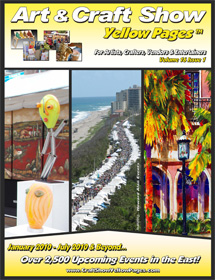
Art & Craft Show
Yellow Pages ™ is now Online for
only $48.95 a year! Faster and easier to find more events, Printed
On-Demand for current subscribers only at $15.00 Each Print (Includes
Priority S & H).
Click Here to Browse Our Online Database of Events
for Sample Event Listings - Now
Nationwide!
Sell your arts and crafts at Fairs & Festivals. Find out where the
shows are and start selling at local, state and nationwide events. Sell
at farmers markets, sell your art at street fairs, sell food at
festivals, sell clothing at craft shows, sell jewelry at street fairs
and more.
We list all events Nationwide! We include detail verified information for each event! This is the best source for event information and is ideal for vendors looking to sell their products or services whether you are selling food, promotional items, clothing, antiques, jewelry or any items ranging from hand made to buy and sell.
Subscribe
NOW and get instant access to the most reliable event listing information you can count on!
Art & Craft Show Yellow
Pages is a regional show guide for
craftsmen artists, food vendors and resellers in
Alabama,
Arkansas,
Connecticut,
Washington DC,
Delaware,
Florida,
Georgia,
Iowa,
Illinois,
Indiana,
Kentucky,
Louisiana,
Massachusetts,
Maryland,
Maine,
Michigan,
Minnesota,
Missouri,
Mississippi,
North Carolina,
New Hampshire,
New Jersey,
New York,
Ohio,
Pennsylvania,
Rhode Island,
South Carolina,
Tennessee,
Virginia,
Vermont,
Wisconsin
and
West Virginia
!
Art & craft show listings contain in-depth details and information to help you choose the right shows to sell your arts and crafts, promotional items, food vending, trade or wholesale.
All shows are not
equal.
Choose your shows by targeting your
customer. Will your customer be there?
We even publish information such as:
3 stages of live music, pony
rides, Antique and Classic Car Shows,. . .
- more!
Real show listings with detail descriptions like, event attendance, cost of booth, size of booth, what you can sell at each event or signup deadlines to event. Choose from detailed listings according to your preferences; we let you know if a show is indoors, outdoors, in tents, or in a mall. We even publish eligibility requirements, - so you will know if a show is an 'Open Show' a 'Juried Show' or trade or wholesale shows. If a show is predominantly Contemporary, Traditional, or Country , we print that information too, to help you find the right venues to sell your work.
ART and CRAFT SHOW YELLOW PAGES is the most important tool in your business kit! Subscribe with confidence! We guarantee it will help you with your business, or we'll refund the balance of your subscription!

See: www.craftshowlist.com, www.craftsfairguide.com, www.craftmasternews.com, www.artsCraftsShowBusiness.com, http://www.1nbcard.com/artisan.html
|
List your Art & Craft Shows, Fairs, Festivals, Street Fairs, Garden Shows, Trade & Wholesale shows - |