















Craft Show
Yellow Pages
©
Toll Free:
(800) 871-2341
Tel: (562) 869-5882
Fax: (562) 904-0546
Office Hours:
M-F 10am-8pm EST


Marketing on the InterNet
|
by the World's First Web-Dancing Frog™, - ElJay C. "Build It and They Will Come!"Not exactly! This is virtual reality, sweetie, - not baseball, - as in "Field of Dreams" where they built a stadium . . . and everyone came! The truth is, even if you hire someone else to create your website, you have to decide what you want it to do, and how it should work to do that. (You wouldn’t let someone create a tri-fold brochure for you without telling him what you want.) Just because you don’t know much (or anything) about webspeak or software, doesn’t mean you can leave it all up to someone else. Do you drive a car? Did you buy a work-horse (a truck or a van, etc. ) or a passenger car? If you bought the right car for the job, and you make sure it gets regular maintenance, it does what you want it to do, and you don’t need to know about the little explosions in the cylinders, etc. Websites are kind of like that. If they are built right in the first place, they work, - but they do need regular ‘maintenance.’ Is it ‘Built Right?’“How would I know if this is the right kind of website for me? They all look very nice!” Mon cher’ petite, believe me when I tell you that beauty is only skin deep, - n’est pas? What you see is the outside, the skin. I look under the pretty skin, - so deep, I can tell you why you have no sales. Your source code needs the right keywords and descriptions . Right click your mouse on a webpage, (away from the graphics, on text or an empty spot on the page.) On the drop-down menu, choose “View Source.” Voila! What you see is the source code. (You can save this to your Desktop, choose File, Save As: webpage.html, - or whatever.) Look at the source code in the heading. (The first few lines are the heading, it includes everything between the two tags: <HEAD> . .. . . . . . and the </HEAD>.
We cover the following Eastern US States:
Does Each Web Page Have Keywords and a Description?Search engines need keywords and description to find your site. They should be in this order near the top of your source code: <HEAD><TITLE>The words that you insert here will appear in the field at the top left of your web page in the color bar . </TITLE> <META name= "description"< /FONT> content="This is where your description goes: one good sentence, or two short ones describing your site, product, or webpage < /FONT> ."> <META name="keywords" content="Your keywords belong here: individual keywords, such as: “hand-crafted, handmade, handcrafted,” and groups of keywords, separated by commas, e.g: “Country-style wooden furniture, hand-crafted chairs and tables, handcrafted wood furniture made of oak and maple”, etc. "> </HEAD> <- That means " This is the end of the Heading."
Your most important keywords should be in the beginning of the statement, then along about the middle add your business name. If it might be misspelled, also put it in your keyword list misspelled just the way you think someone might spell it if he were looking for your site on a search engine! There may be other ‘meta-tags’ in the heading; e.g.: your software automatically sets a statement, e.g. if you use MS FrontPageä it will have a meta-tag that says “FrontPage.” It’s kind of like “Kilroy was here, ” or "I made this!" If someone else creates your website, YOU must create your own keyword list, and also the description. Get out on the web, even if you’re a newbie, and have someone help you search for sites of products similar to yours.
Look at the search-engine’s description of their site. The description is taken directly from their source-code’s heading. Go to these sites, right click, view their source code, and look at their keywords! After you’ve seen five or six different sets of keywords you’ll get a feel for what to include in your own keywords and description. You needn’t copy theirs, this is research, - it only points the way. The important thing is to figure out how would someone search for your product? What words would they use? That’s what you need to put in your source code. The description should be condensed but interesting enough to take them to your site . The Keywords Must be "True"What does that mean? Well, I can put "Louisiana Fried Country Chicken & Sprouts" in my source code, but if the words don’t appear on the page, that mean old search engine will decide that I lie, - me: the great green frog. Sacre bleu. So, what do you do? You make it a heading: Louisiana Fried Country . . .etc . Then describe the chicken, under a mouth-watering picture, repeating some of the keywords: “This wonderful recipe is from my mother who grew up in Louisiana. She used to help aunt Sara fry up the best, mouth-watering Country Fried chicken . . . . Our chickens are plump and juicy, country-bred . . .” Repeat as many of the primary keywords as possible. Keywords should be optimized for each page: if you have Sweet Country Pickles on another page, you wouldn’t use the "chicken" keywords in that page’s heading. Repeat your Keywords in the graphics code. There is a place in the code when graphics are inserted on the page for one to put an alternative description, e.g. “alt= etc.”. It can describe the graphic, or you can use it to repeat keywords. You can describe it as ‘chicken’ or “Louisiana Fried Country Chicken & Sprouts” in the alternate description to echo your most important keywords on the page, or tell your website designer to do this for you. There you have it my little tadpoles. One of the best-kept secrets in the industry, from your very own green friend. Just between us, - maintenance is easy, (hint: you can register your site on 30 top search engines, free—on http://www.addme.com .) Do it every 60 days, or 3,000 miles, whichever comes first. We will talk again, cherie. Your hopping green friend, ElJay, the World's First Webdancing Frog™ |

|
New England & Northeast
Art & Craft Shows, Fairs
[FORMS for Show Promoters]
[Resources:
Sources, links]
[Our Team] [SUBSCRIPTION INFORMATION] - [Email] - [Home] |
| Buy Now! Subscribe only 48.95yr |
 |
Call us toll free at:
(800) 871-2341
We list detailed information about the following events:
•Art and Craft Shows
•Fine Art and Fine Craft Shows
•Street
Fairs and Festivals
•County
& State Fairs
•Home
& Garden Shows
•Farmer's
Markets
•Antique & Collectible Shows
•Music Festivals
•Car Shows
•Holiday & Gift Shows
...and much more.
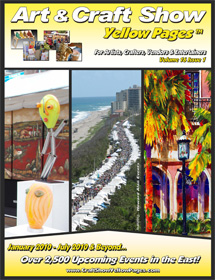
Art & Craft Show
Yellow Pages ™ is now Online for
only $48.95 a year! Faster and easier to find more events, Printed
On-Demand for current subscribers only at $15.00 Each Print (Includes
Priority S & H).
Click Here to Browse Our Online Database of Events
for Sample Event Listings - Now
Nationwide!
Sell your arts and crafts at Fairs & Festivals. Find out where the
shows are and start selling at local, state and nationwide events. Sell
at farmers markets, sell your art at street fairs, sell food at
festivals, sell clothing at craft shows, sell jewelry at street fairs
and more.
We list all events Nationwide! We include detail verified information for each event! This is the best source for event information and is ideal for vendors looking to sell their products or services whether you are selling food, promotional items, clothing, antiques, jewelry or any items ranging from hand made to buy and sell.
Subscribe
NOW and get instant access to the most reliable event listing information you can count on!
Art & Craft Show Yellow
Pages is a regional show guide for
craftsmen artists, food vendors and resellers in
Alabama,
Arkansas,
Connecticut,
Washington DC,
Delaware,
Florida,
Georgia,
Iowa,
Illinois,
Indiana,
Kentucky,
Louisiana,
Massachusetts,
Maryland,
Maine,
Michigan,
Minnesota,
Missouri,
Mississippi,
North Carolina,
New Hampshire,
New Jersey,
New York,
Ohio,
Pennsylvania,
Rhode Island,
South Carolina,
Tennessee,
Virginia,
Vermont,
Wisconsin
and
West Virginia
!
Art & craft show listings contain in-depth details and information to help you choose the right shows to sell your arts and crafts, promotional items, food vending, trade or wholesale.
All shows are not
equal.
Choose your shows by targeting your
customer. Will your customer be there?
We even publish information such as:
3 stages of live music, pony
rides, Antique and Classic Car Shows,. . .
- more!
Real show listings with detail descriptions like, event attendance, cost of booth, size of booth, what you can sell at each event or signup deadlines to event. Choose from detailed listings according to your preferences; we let you know if a show is indoors, outdoors, in tents, or in a mall. We even publish eligibility requirements, - so you will know if a show is an 'Open Show' a 'Juried Show' or trade or wholesale shows. If a show is predominantly Contemporary, Traditional, or Country , we print that information too, to help you find the right venues to sell your work.
ART and CRAFT SHOW YELLOW PAGES is the most important tool in your business kit! Subscribe with confidence! We guarantee it will help you with your business, or we'll refund the balance of your subscription!

See: www.craftshowlist.com, www.craftsfairguide.com, www.craftmasternews.com, www.artsCraftsShowBusiness.com, http://www.1nbcard.com/artisan.html
|
List your Art & Craft Shows, Fairs, Festivals, Street Fairs, Garden Shows, Trade & Wholesale shows - |