















Craft Show
Yellow Pages
©
Toll Free:
(800) 871-2341
Tel: (562) 869-5882
Fax: (562) 904-0546
Office Hours:
M-F 10am-8pm EST


~ What Happened to Our Shows? ~
An Examination of the Marketplace
Here, in New York' s Hudson Valley, craftsmen have been complaining about the show scene, and to a certain extent they're justified. Part of the reason that shows have been off is the economy. Despite reports that the economy is booming, the boom is limited to certain industries, in certain sections of our area.
Electronics and telephone system installations for small companies (100 employees or less) is on the upswing in this area, -among other industries, and there is an upswing in the real estate market, south of Rte. 55. This area is experiencing an influx of minorities and low-income people from New York city as they bring their familes to the area to enjoy better standards of living.
Six years ago IBM closed its plant in Kingston and buildings in Fishkill and East Fishkill emptied as they transferred personnel out of state, and laid off thousands. The economy has never truly regained confidence as those who are still working for IBM await the sword.
We cover the following Eastern US States:

*If
you
would like to mail your credit card information, or to send a check,
click
here for an order form to print out. Then fax or mail it in.)
Local businesses
depending on IBM corporate business have folded, e.g. the little
rent-a-car outpost on the outskirts of Kingston was one of the first to
bite the dust. It was heavily-dependent on traveling executives, and
they could no longer justify staying open. The economy also affected
many restaurants and retail stores.
In the midst of
this climate comes the big retail super discount stores, edging out the
little Mom-and-Pop appliance stores, office equipment. building
supplies, gift shops, - and others.
Dutchess County
is over-retailed. The Poughkeepsie Galleria made a splash as the first
major mall in the area about 12 years ago; we watched small stores
migrate to the malls or go under. It is going to start construction to
double its size, a demographicly unjustified move in my opinion.
Our local economy
is only one of hundreds, nationwide, undergoing changes as major
corporations downsize, -including General Electric, Kodak, Douglas,
Cocoa-Cola, etc.
NAFTA and
preferred-nation status also have their finger in the pie; the fallout
is evident in the proliferation of cute little import stores. 'Buy
American' is no longer a battle-cry. Who can 'buy American' when car
parts are Japanese-made and assembled in Canada, wear American brand
names, and appear to be American-made? Well, "-not exactly" as the
commercial says.
Consider the
'graying of America.' As Charley Dooley (Craftproducers) so
accurately described in a letter to his craftsmen a year or two ago,
the market has changed. People who have supported the craft market in
the past are older, their kids are grown and living on their own;
they've downsized their homes, and they don't have room for more
"stuff."
Their children
work, but they're not going to buy the same . stuff. they
grew up with. They want new, innovative, unique products to live with,
- and they are willing to pay for them.
The market for
high-end items is wide open. People are willing to buy at high-end
shows. Price is no object if they want it.
Inexpensive items
sell well, they always have. (Consider the $5 thingee-on-a-stick fad.)
It's the skilled
craftsman who produces medium-priced work whose sales are down across
the board. Some craftsmen buy imported Teddy Bears or cloth
frogs, slap a vest or a hat on them, and sell them as hand-crafted.
They have no idea how they are sabotaging their own markets. Customers
recognize these items, and are turned-off. Why go to a craft show to
buy imports? They can buy them at the mall.
Add to these
circumstances a proliferation of craftshows unmatched in memory, and
you. ll see why customers who have been enthusiastic are becoming jaded.
SHOWS: Survival of the Fittest
As I collect data for Art
& Craft Show Yellow Pages™, I come across many shows
that have been cancelled. Sometimes the show was more trouble than it
was worth as a fund-raiser. The community didn't support it, the
craftsmen complained, and it became more difficult to raise money for
their project, so they cancelled the show. It's a shake-out of the
marketplace, and good for the industry as a whole.
Some shows are in
the right demographic area, run by knowlegeable and concerned people.
There are successful shows in other than the best demographic areas; it
depends on the show organizer, the type of show, the amount of
advertising he does for the show, what else is going on in the area
that may conflict with the show, (major league football games,
appliance/clothing sales, good weather, bad weather, job layoffs,
etc.) Some of these things are out of your control, but there
are factors you can use to put the odds in your favor.
Established
professionals usually, (but not always) have an edge over volunteers
who have a personnel turnover every few years. Network with
other craftsmen in your price-range to find good shows.
If possible,
before you sign up for a show that is significantly more expensive than
your usual show, go as a customer. Will your work fit in here? Is the
quality, range of prices, etc. comparable? Is your display as
professional as these? This type of evaluation can save you
disappointment, and inspire you to grow and try new venues.
To
Maintain Sales
Schedule a few new shows every year. The old favorites you schedule every year will eventually change, or you'll saturate the area with your product, and you may need to replace them.
Within Your
Control
Create higher-end work while
you continue to produce your regular line, and watch your customers'
reactions; listen to what they tell you when they handle the piece.
Eventually your work will evolve as you learn to assess the market.
Be willing to
travel a bit fartheror in new directions . Sometimes a show in a nearby
state is closer than one at the other end of your own state. Get a tax
certificate so you can sell your work there, and test the waters.
Keep your product
pure, within reason. Don' t use manufactured or imported work as the
main part of your product. A small component part of a piece may be
manufactured or imported, and it won. t detract from the piece, such as
a catch on a necklace, but consider how much better it would look with
a hand-crafted finding. If it's an expensive piece, the extra effort is
more than worth it, because a manufactured finding lessens the value of
your work.
Upgrade your
skills by taking classes. Add new dimensions to your work with by
experimenting with new techniques and materials.
Unfortunately,
none of these solutions will work for everyone. There are no simple
answers. The shows have changed; these are simply circumstances that
feed the change.
Nothing is
static. Everything changes, evolves and grows. The survival
of The American Craftsman depends on his willingness to adapt, to be
assertive in his choices, to evolve and grow in technique and
creativity to meet these changes. It's up to you.
[Our
Team] [SUBSCRIPTION
INFORMATION]
- [Email] -
[Home]
Free 7 Day Trial to Craft Show Yellow Pages or Craftmaster News!
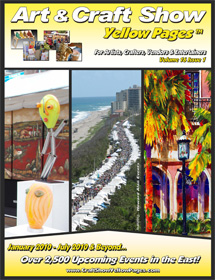
Art & Craft Show Yellow Pages is your #1 Reliable source providing detailed information about Art and Craft Shows, Fairs and Festival. The Online Show Listing System for Crafters, Artist, Vendors and Event Promoters.
When you subscribe to Art & Craft Show Yellow Pages not only will you get 24/7 online access to our unique copyrighted data, but you can also request at any time a printed copy for an additional $15.00 dollars each print (Includes Priority S & H) as long as your subscription is current.
Your one year subscription (1 yr) includes instant access to our online system and as a current member you can benefit from Print-on-Demand, our exclusive member service that allows members to request printed copies of the most current events for an additional $15.00 dollars each print (Includes Priority S & H)
-
Rent your booth today! Get contact information to each show NOW!
-
Get Detail information about each show easy and fast with our copywriting quick code format.
-
Google Geo Coded Radius Zip code search
-
Show Reviews & Comments by Exhibitors
-
Easy-to-Read Listings & Reviews
(with our copyrighted data arrangement & organization) -
Read your show listings on the GO! Optional Print-on-demand book!
-
Save on printing costs by using Art and Craft Show Yellow Pages
-
The Most Complete, Accurate, & Up-To-Date Show Listings, Guaranteed!
| Buy Now! Subscribe only 48.95yr |
 |
Call us toll free at:
(800) 871-2341
We list detailed information about the following events:
•Art and Craft Shows
•Fine Art and Fine Craft Shows
•Street
Fairs and Festivals
•County
& State Fairs
•Home
& Garden Shows
•Farmer's
Markets
•Antique & Collectible Shows
•Music Festivals
•Car Shows
•Holiday & Gift Shows
...and much more.
Art & Craft Show
Yellow Pages ™ is now Online for
only $48.95 a year! Faster and easier to find more events, Printed
On-Demand for current subscribers only at $15.00 Each Print (Includes
Priority S & H).
Click Here to Browse Our Online Database of Events
for Sample Event Listings - Now
Nationwide!
Sell your arts and crafts at Fairs & Festivals. Find out where the
shows are and start selling at local, state and nationwide events. Sell
at farmers markets, sell your art at street fairs, sell food at
festivals, sell clothing at craft shows, sell jewelry at street fairs
and more.
We list all events Nationwide! We include detail verified information for each event! This is the best source for event information and is ideal for vendors looking to sell their products or services whether you are selling food, promotional items, clothing, antiques, jewelry or any items ranging from hand made to buy and sell.
Subscribe
NOW and get instant access to the most reliable event listing information you can count on!
Art & Craft Show Yellow
Pages is a regional show guide for
craftsmen artists, food vendors and resellers in
Alabama,
Arkansas,
Connecticut,
Washington DC,
Delaware,
Florida,
Georgia,
Iowa,
Illinois,
Indiana,
Kentucky,
Louisiana,
Massachusetts,
Maryland,
Maine,
Michigan,
Minnesota,
Missouri,
Mississippi,
North Carolina,
New Hampshire,
New Jersey,
New York,
Ohio,
Pennsylvania,
Rhode Island,
South Carolina,
Tennessee,
Virginia,
Vermont,
Wisconsin
and
West Virginia
!
Art & craft show listings contain in-depth details and information to help you choose the right shows to sell your arts and crafts, promotional items, food vending, trade or wholesale.
All shows are not
equal.
Choose your shows by targeting your
customer. Will your customer be there?
We even publish information such as:
3 stages of live music, pony
rides, Antique and Classic Car Shows,. . .
- more!
Real show listings with detail descriptions like, event attendance, cost of booth, size of booth, what you can sell at each event or signup deadlines to event. Choose from detailed listings according to your preferences; we let you know if a show is indoors, outdoors, in tents, or in a mall. We even publish eligibility requirements, - so you will know if a show is an 'Open Show' a 'Juried Show' or trade or wholesale shows. If a show is predominantly Contemporary, Traditional, or Country , we print that information too, to help you find the right venues to sell your work.
ART and CRAFT SHOW YELLOW PAGES is the most important tool in your business kit! Subscribe with confidence! We guarantee it will help you with your business, or we'll refund the balance of your subscription!

See: www.craftshowlist.com, www.craftsfairguide.com, www.craftmasternews.com, www.artsCraftsShowBusiness.com, http://www.1nbcard.com/artisan.html
|
List your Art & Craft Shows, Fairs, Festivals, Street Fairs, Garden Shows, Trade & Wholesale shows - |